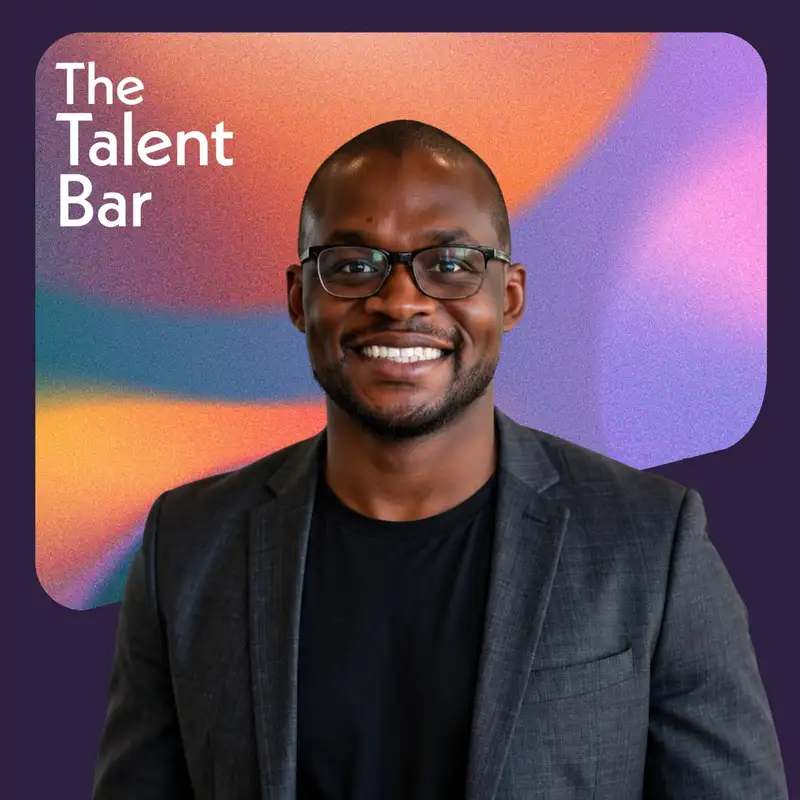
TTB - Mawulom Nenonene
===
[00:00:00]
squadcaster-ca1h_3_08-19-2026_103523: Hello, everybody, and welcome to today's episode of "The Talent Bar." I'm so excited to have our guest with us today. He and I actually, crossed paths in our professional lives, uh, several years ago.
But he's actually somebody, I think, in terms of guests, that has one of the most, um, interesting career paths of anyone I've had on the show. He started his career developing, uh, weapon systems for the US DOD, spent nearly seven years as a mechanical engineer qualifying manufacturing products, working with defense contractors, and then he made a pivot, um, moved to Silicon Valley.
We'll talk a little bit [00:01:00] about how and why he decided to do that. Started sourcing engineers at Google and spent the last decade building and leading talent functions at startups like Thumbtack, BetterUp, where we were together, um, the Long Term Stock Exchange, and Point. Now he's building a recruiting engine from scratch at an early-stage startup scaling from 18 to 80, and we're gonna talk a little bit more about that.
He is a talent leader, coach, and advisor currently building at Flux. Welcome to the show
mawulom-nenonene_1_08-19-2026_103523: Thank you so much. This was such a, such an amazing intro. I appreciate your thoughtfulness in outlining our shared connection as well as my history, and I'm eager to actually connect with you. I've watched you in terms of your career from afar, and I'm-- I just felt a sense of pride knowing that we were able to build together
squadcaster-ca1h_3_08-19-2026_103523: Yeah. I'm so excited that we could. Um, well, I, I do like to start the show with asking everyone a pretty similar question of all my [00:02:00] guests, which is, you know, particularly when we're, we're thinking about talent acquisition and what you need to build good teams, like what do you need to see in a really good recruiter?
What makes a good recruiter better than, or what makes a great recruiter better than a good recruiter? What are some actions or philosophies that you think, um, really make that distinction?
mawulom-nenonene_1_08-19-2026_103523: That is a really good question The, the way you phrased the question, I immediately thought the Tao Te Ching. I thought of right action. Um, and in that wisdom book, it talks about several um, mixed with the art of war, which is if you cannot gain one step without holding it, don't take a step. If you don't know what to do, do nothing. And so I think about right action. A good recruiter is an individual that knows the job, is effective at what they do. They hit their [00:03:00] targets. Um, they leverage data and tools as needed. Now, a great recruiter is someone that understands the why. They are steeped in the overall organization. A great recruiter may say no to a candidate that they've fallen in love with and brought through the process, but at-- through the later stages, they realize that it's not a fit, uh, based on where the organization is or specifically based on where that person is going.
So the biggest difference from good to great, um, Sidebar, one of my favorite books, Jim Collins, check it out, would be a thorough understanding of the organization's disposition and where the gaps are. Um, you're not just hiring to fill the role when you're great. You're hiring to embody the team to support a high-performing output
squadcaster-ca1h_3_08-19-2026_103523: when we were first talking about this and you said, like, no action is better than the wrong action, I think my initial thought was, well, [00:04:00] there's always a right action.
Like, you just gotta figure it out, right? We, especially in startup world, we don't really see no action as an option in a lot of, in a lot of ways. But I think tying that into what you were saying, particularly in recruiting, is all about, you know, not hiring the wrong person because the subsequent impacts of that can be pretty significant.
So I, I don't know. Is that, is that one practical way you think about that advice?
mawulom-nenonene_1_08-19-2026_103523: Wholeheartedly. And if you think about the tools that we have right now, wrong action could be sending out 8,000 messages to the wrong candidates. Let's say you're hiring an engineering manager, and you are using an automated tool that's fully untested, you send out 5,000 of those messages to individuals that are not even in your geo, that are college students, um, and the other side of the world.
And the other half go to [00:05:00] individuals that are in your geo but are not directly fit for the role. And so that creates a, a, a negative impact to your company brand and also increases your time in terms of getting back to those candidates and whatnot. So, it's not the way I started recruiting, but it's the way I look at it right now.
The, difference between good and great has a component of strategy in there, where the great recruiters or great talent partners are thinking through processes, thinking through outcomes and touch points, and are able to move individuals through this challenging part of their lives, um, frictionlessly.
squadcaster-ca1h_3_08-19-2026_103523: okay. I wanna talk a little bit about how you got to where you are. You, you know, you spent nearly seven years at, at the DOD as a mechanical engineer, um, and then you became a technical sourcer at Google. Like, how did, how did that happen?
mawulom-nenonene_1_08-19-2026_103523: The long [00:06:00] version or short version?
squadcaster-ca1h_3_08-19-2026_103523: Whatever you feel like sharing
mawulom-nenonene_1_08-19-2026_103523: So it started with, uh, Mitch Bowman, my first branch chief at DoD. Mitch gave me an opportunity to build, and I will say, um, starting, starting there, I did that because of how I interviewed. I-- When I-- By the time I started interviewing, I had at least 40 interviews during my collegiate years.
One of my mentors suggested I do 10 interviews a year, um, even after I secured a role. And so when I was interviewing for the position, not only did I seek insights from individuals that were there, my very good friend, Jose Carpetero, reminded me that we interview as if we already have the role. So I did as much research as I could. I showed up with a binder filled with how I would approach the role at different stages. And I, I share that because I think in recruiting it's important to understand that preparation [00:07:00] really does make an impact to how you show up. Um, now in terms of the journey, I spent f-- um, quite a bit of time at the DoD. The first 80% of my time was spent traveling through the US qualifying and building these manufacturing plants. The other 20% was focused on internal team. Uh, we were initially selected to solve the groupthink problem, which is, hey, how do we ensure that the engineers that we have are able to iterate fast?
And that meant individuals from different walks of life, folks that have lived in farms, lived in cities, that went to different colleges. The goal was to find various ways for-- various ways of thinking and bring them into a room. And in 2010, my mother passed. Um, in 2011, my father passed, and at that time, I started looking at my life less as this amazing adventure that I was on and more as a, a time, a limited amount of time [00:08:00] that I had.
And during that time, my partner and I had a young child, and in our grief, we had a fridge full of magnets. Um, I think I've told this story a lot of times, but took the magnets off and wrote a question, "What do you love?" Because in our grief, we realized that we had a limited amount of time, and we wanted to fill our lives as much as we could with the things that fed us, that we loved. We were aware that there were things that we needed to do to maintain a lifestyle, but we identified what we loved, we wanted to increase the, the amount that-- of time that we gave to that.
squadcaster-ca1h_3_08-19-2026_103523: Yeah
mawulom-nenonene_1_08-19-2026_103523: few months later, I realized that it was recruiting for me and knocked on a few doors. I had some interviews, and there was a, a very thoughtful woman in Florida that just ripped my resume apart. She's like: "You are an engineer. You're managing this $50,000-- $50 million program. You did all this. Yeah, that means nothing, okay? Focus on what matters. Um, how many candidates did you interview?" Talk about the conferences, the talks, [00:09:00] the work, the belonging work you did on base. And it changed my paradigm for viewing roles, and I carry that now still. Um, I started an interview at-- I connected with my network, got referred into Google, um, had an interview and then nothing for maybe two months. And I yeah, I reached out to a number of people online. Uh, one of them, I forget her name. No, Michelle. I forget her last name. She connected me with a member of another team and, um, I was able to interview, go through that process and join as a contractor.
Apparently, the individual that was running my interview left and dropped the ball, but it worked out really well.
squadcaster-ca1h_3_08-19-2026_103523: Mm-hmm.
mawulom-nenonene_1_08-19-2026_103523: So that was a journey from West Coast to East Coast
squadcaster-ca1h_3_08-19-2026_103523: Yeah. Well, uh, how, how has, uh, you mentioned, um, and one of the things I, you know, I learned about you as I was researching, uh, to have you [00:10:00] on this show was you helped counsel people and you talked about the belonging work. Like, how has that shaped how you think about people leadership now?
mawulom-nenonene_1_08-19-2026_103523: Significantly. Um, I was fresh out of college and thrown into this world where I was given EO training. I worked on a number of employment relation matters. Um, vividly remember going to West Point to do a negotiation. And so that impacted how I viewed the world, but I was still, um, unseasoned in the sense that I didn't unders- I didn't fully unders... It changed my overall approach where I became more self-aware of the nature of the potential negative consequence or the ripples of actions. But I, I wasn't as seasoned then. Um, now, after a few cycles, it has significantly impacted how I view leadership. I think that as a leader, it's a tremendous [00:11:00] responsibility. Personally, I've worked with a number of founders. We're talking 22-year-olds, uh, right out of school to 65-year-olds that want to build something, uh, self-funded, no funded, um, VC funded on their third or fourth round. what I have found to be true is that some of the best leaders that I've worked with have a few things in common.
One, they don't make the same mistake more than once. And I worked with an amazing founder where I just couldn't understand his ability to iterate. And again, that's the bar, right? Mistakes are gonna happen. We're building. Other founders, they have the ability to iterate. I mean, they-- If you're leading a team and you're busy and your team feeds you information that's incorrect, and you learn later on that it was an error, they clean it up. And so founders that have principles are the ones that I believe thrive well. Um, fortunately for me, I've only worked with one founder [00:12:00] that, know, maliciously impacted the team, and those are what I would watch out for. I would say that if you're building a company, if you're building a team, think about systems that you're building it on.
Like right now we have-- we're in a building. There are engineering principles that allow this building to stand. Yes, or main- uh, you require maintenance. But oftentimes in organizations, we think about values, and those values are tied to ethereal moral things that are-- It's harder to bring a community together,
squadcaster-ca1h_3_08-19-2026_103523: Yeah
mawulom-nenonene_1_08-19-2026_103523: on values, especially since they may have different shared va- they may have different values in general.
But the principles, the foundational principles that you build on, if you can build that within yourself, and one of them could be do what's right. Simple as that. And that means that if you believe this is the right action today, do your best to do that. If months later, a year later, you realize that that was the wrong action and there's a way for you to clean it up, [00:13:00] what's right then. that is one thing that I would offer leaders, and it's also why when you asked that question, I went so far back. Um, I think that leadership is, it's a heavy responsibility, and oftentimes the reluctant leaders, such as yourself, are the ones that are best suited to drive us forward.
squadcaster-ca1h_3_08-19-2026_103523: you said something when, when we talked previously that, and you, you touched on it a little bit here, but, um, you've watched leaders that are ruthless but consistently fair.
mawulom-nenonene_1_08-19-2026_103523: Yes
squadcaster-ca1h_3_08-19-2026_103523: what you're talking about now is consistency is actually what built trust. Like, say more about how you think about, um, how you think about the ruthless but consistent, um, dynamic.
mawulom-nenonene_1_08-19-2026_103523: Let's say half a decade ago, I was focused on pleasantries. I wanted-- I would coach leaders to do what's right, but personally, if you weren't kind, and [00:14:00] kindness was just determined as that. If you were-- If we were sitting at a dinner table negotiating a conversation and you were rude, I would look at that as to the waitstaff that, "Hey, this is someone that I, I may not want to work with." Whereas now I look at that interaction, I would sit through that interaction, and if you had an amazing meal and the rest of the service was great and you tipped 50%, know, I would, I would rather work with that person. So as I've matured, I've realized that in the, principles that individuals live by are easily identified by their outward behavior. And we as humans, we are complex beings. There are founders that are under tremendous stress, not just because of the organization, but because of life. I've worked with founders where until eight months into our journey, I had no idea that their partner was passing away. And so that impacted their-- They were honoring, but they were fair and consistent.
So now when I look at organizations, when I look at [00:15:00] leaders, um, you can be ruthless in the sense that you're focused on the overall end goal. You're focused on dollars and cents, but at the same time, you apply that ruthlessness consistently. it's not-- And if you have that consistency, I view that as you're a fair, thoughtful individual. If you are kind and thoughtful and you apply consistently, great. If you are very nice and yet you choose to play favoritism, you choose to use your power for the few, um, that's where things get a little interesting. So again, as I've matured, it's less about the overall current disposition of the person and more about what they do regularly. And it's, this is super anecdotal, it's bespoke to myself, but I've met more founders that are fair and consistent that have shown their full range of emotions than [00:16:00] the other kind. Founders that are less fair, less consistent, and they have been skilled in the art of the Machiavel-- how is it? Machiavellian games of court per se.
squadcaster-ca1h_3_08-19-2026_103523: Yeah
mawulom-nenonene_1_08-19-2026_103523: And that to me is very, very dangerous because you're impacting people's lives. Um, this is-- We can spend so much time at work. This is how people feed their families at times. At times, um, I've personally lost a dear friend to one such malice, and I kid you not, I, I left the base shortly after because, uh, there were other things that drove that, but I was so disheartened,
squadcaster-ca1h_3_08-19-2026_103523: Yeah
mawulom-nenonene_1_08-19-2026_103523: because at the time I didn't understand how a human leader would behave that way and be so inconsistent.
So I hope that brings a bit of thoughtfulness to it. Now, when I look at an individual, I don't care if you're crass , I don't care how you move through the world. Are you fair? Are you consistent? Can I see the [00:17:00] principles? If I think through it logically using a, a first principles framework, can I clearly identify your why? And if I can and it's consistently applied, you and I will work together
squadcaster-ca1h_3_08-19-2026_103523: Yeah, I, I, a, a lot of what you're saying resonates with me. I, I still think there's a little, you know, a li- a little bit of a line on the... I, I hear you, and I don't think you're advocating for people to be, you know, overly rude or crass
mawulom-nenonene_1_08-19-2026_103523: absolutely not
squadcaster-ca1h_3_08-19-2026_103523: right? Um, and sometimes frankly, I think in the Bay Area we are more accepting of some of that than, you know, what I've experienced in other, in other places.
And, and we sort of write it off to, "Well, they're just this brilliant founder, and so, you know, they can, they can behave that way." And, um, luckily I haven't crossed paths with too many of folks like that. But, um, you know, I, I, I like what you're saying about the consistency because I do think that what that sort of f- oh, it's a found- founder energy or, or whatever can sometimes, [00:18:00] um, be an excuse for that inconsistency, the game playing and all that kind of stuff that it, it is ultimately pretty unhealthy for, for the culture of an organization to succeed.
mawulom-nenonene_1_08-19-2026_103523: Agree. And outside of my own experience, I would say one of the experiences that I witnessed was a honorary founder that, you know, was in a position where, let's just say the-- they had to force a decision to release one of their longtime colleagues, uh, someone that helped them build the organization. And it was the right thing to do.
It was fair. Um, but that person was going through some things personally. And a week after that, um, the-- let me know they-- that I should reach out. And when I reached out, uh, the person that was released said: "Oh, yeah, they paid off my house." I'm like: "What?" And the founder said: "Yes, I will consistently apply the fair principles, but here's a person that I love dearly, [00:19:00] and I happen to have more resources, and so I made it right." And that was the first light gave me insights into, hey, when you move with principles, irregardless of the disposition or the role or the hat that you have to wear, no matter what, you're going to do what you need to do to live by those principles and make people whole. And it, it touched me greatly
squadcaster-ca1h_3_08-19-2026_103523: Yeah. Um, okay, I want to shift a little bit. You know, we, I mentioned at the top of the call you're, um, currently working at Flux just, you know, helping build out that organization. You know, the goal is to hit, I think, close to 80 people by the end of the year, and you're at, you know, a- about a quarter, uh, of that right now.
mawulom-nenonene_1_08-19-2026_103523: Yeah
squadcaster-ca1h_3_08-19-2026_103523: where, where are you starting? How are you building that, um, recruiting engine there?
mawulom-nenonene_1_08-19-2026_103523: So it started off by really just looking at what the team had. Um, there were some ad hoc co- processes that were created. in-- typically [00:20:00] I, one, I want to understand the entire process. So I want to find out what's written, what's not, and then watch how candidates are brought through the entire interview process, how they're found, how they're qualified, how offers are given, how they're onboarded. And by oftentimes in a startup ecosystem, you know, you can only watch for so long, and by so long, I mean one week. You're di- you're diving into the deep end
squadcaster-ca1h_3_08-19-2026_103523: On a 90-day ramp up, yeah.
mawulom-nenonene_1_08-19-2026_103523: Exactly. And so the next iteration of this is taking candidates through the entire process myself, identifying the gaps. And I like to start off with Eng simply because I've had a lot of success in creating data-driven systems in Eng.
And if you could take 180-day hiring timeline to six weeks, it's easier to bring other parts of the organization in, into that process. So essentially, that's was the start of it. We identified the gaps, and then we iterated. We decided how we wanted to [00:21:00] qualify candidates, how we wanted to measure them. And from there, um, the next step is looking at candidates, looking at the overall candidates that were coming in, and looking at the market.
Uh, there was a short amount of time where we wanted to improve in o-onboarding. We also, personally, um, I received a number of candidates that were just fraudulent candidates, individuals that were not who they said they were. And I'm not talking about folks with fake resumes. I'm talking about complete identity fraud. And if you're in this talent game, you've seen this as well. And we shifted, I would say maybe seven weeks ago, we shifted to a more on-site focus. We wanted to bring individuals on site as much as possible, uh, to get better signal. So if you are looking for a step-by-step guide into, uh, as to how I've approached this, I have a first 40-day framework.
It's on Medium or LinkedIn, you can find that.
squadcaster-ca1h_3_08-19-2026_103523: Okay.
mawulom-nenonene_1_08-19-2026_103523: The-- what you [00:22:00] don't under- what I don't share is the relationships, right? While you're doing this work, you're building relationships. Again, when I think about a great talent partner, I think about someone that understands the organization as a whole and is able to adjust accordingly. So while this is happening, I'm getting to know the team, I'm getting to know, um, the leadership, and I'm getting to know how we work regularly. I'm actually in our office right now. And so that has given me quite a bit of insights to drive solutions accordingly. And there's individuals that I talk to that, you know, they are-- they live 90 minutes away. They love the organization. They have their first kid, and I, I, I think they would crush our interviews, but it's, it's an in-office role, so it's not the right fit. I've been able to do that thoughtfully. Um, when I think about scaling further, throughput is amazing. What is for us to scale [00:23:00] is hiring in more individuals that can actually interview
squadcaster-ca1h_3_08-19-2026_103523: Yeah. Yeah. How are you thinking about scaling that up?
mawulom-nenonene_1_08-19-2026_103523: Oh, so love that you asked that. Um, so we actually have an engineering manager role open right now, and that is our head of product's brainchild and head of eng. And so once that individual gets hired, I expect that we would actually increase the number of interviews we can have weekly. I would say one month after they're there, we would be able to run through an additional 10 interviews, hiring manager interviews a week. Uh, that doesn't seem like a lot, but if you look at the top of funnel where we are on quality in the sense that the candidates that go into our pipeline are pre-qualified by our head of product and our head of eng. Since that has started occurring, I believe our data shows that we went from a 50% ratio of individuals [00:24:00] passing the initial screen to closer to 75%. And so any-- If you-- If we put 10 candidates top of process, that means that the-- if the same process occurs, seven of those candidates should make it to the end goal. Um, me a few months, and I'll let you know how that plays out.
squadcaster-ca1h_3_08-19-2026_103523: Mm-hmm. Yeah. Um, you mentioned sourcing tools. You have shared with me that you, um, cycled through a number of them in the last two quarters, and you, you said your framework is you give a tool four to six weeks to prove itself. Like, what are you learning about AI sourcing tools right now, and, and how are you thinking about the landscape there?
mawulom-nenonene_1_08-19-2026_103523: So I can take you back to a year ago, actually, a year and a half ago, where I started working with the team at Tessi. Uh, some of the folks from Thumbtack built this amazing tool that was phenomenal at some things. I would say within the first-- I tested it out in Q4, not [00:25:00] last year, but the year prior, and within the first month, it went from a junior recruiter to a seasoned recruiter in terms of identifying candidates, responding to candidate questions, as well as scheduling.
So it was incredible. Um, fast-forward to first quarter of this year, Tessi was acquired, and so that stopped. Um, Q1, I worked with Tessi, Findem, and I believe Juicebox on the side and Pin. Um, I was testing out two organizations, which I will not name because I, I did not move forward. So I'm constantly testing out other tools.
When I began testing out Tessi, it was not the main source. It was just a tool that I had a hunch that it would be very positive in. And this all started in twenty-fifteen with CodeFights, which is now CodeSignals, uh, where Geoff Winter at Thumbtack said: "Hey, talk to this guy. Let's see what it is." And in my conversation, not only did I [00:26:00] find a lot of value in what Tekram was building, but it allowed us to actually bring in candidates that were-- did not have the pedigree.
squadcaster-ca1h_3_08-19-2026_103523: Mm-hmm.
mawulom-nenonene_1_08-19-2026_103523: Weren't, they weren't Googlers. They didn't go to Ivy Leagues. They-- Some of them were self-taught community college. But because of their performance on CodeFights, we had enough data to bring them through our interview process, and some of them really, um, surprised us. So since then, I bel-- I made it a point to set a certain amount of time to testing out new products. right now, um, products that test, I do give them four to six weeks. I want to see what the bugs are, what the functionalities are. Are you able to address the, the core concerns? If you're a sourcing tool, how's your messaging? the purpose of the tooling is at times you want to move fast.
If you have a larger team, I would highly advise that you leverage that team size and one or two individuals to test [00:27:00] out these products. These are high performers that you know, know what good is to have a set work framework. If you don't, then I would highly advise that you take on that work, um, so that you're not adding more stressors to your team that who often have metrics and goals to hit. And if you find something that works, it's not just a-- it, it's not just something that works once. It has to work continuously. Um, the tools that I've used last year, some of them are no longer as effective. And when that happens, I often reach out to the overall team, or if I know the founders, I reach out to them. I share feedback often, and then I pause. And once the tool, I often highlight that, "Hey, once you solve this problem, reach back out to me." that changes the nature of it, uh, because on the outside, it can seem as though it's very transactional. I'm constantly running through tools. But the goal is less the tool and more the relationship. And the tools that I use often allow me to [00:28:00] build those relationships. And so currently where we are right now is more so Pin has been... And I know in Q1, I will say this, in Q1 I did doubt Pin a little bit. I did. I did. Uh, uh, just because of the overall output that we were getting. But now I, I would say Pin is the number one tool that we use in terms of talent acquisition, and I expect that it will be for the rest of the quarter.
There are other tools that I'm testing. I will not name them simply
squadcaster-ca1h_3_08-19-2026_103523: Yeah. Yeah
mawulom-nenonene_1_08-19-2026_103523: they have not yielded the results I desire. Uh, one of the things that I do is if something works really well, I share with the world. And when I share with the world, it's for that specific time period. If something doesn't work, it remains nameless
squadcaster-ca1h_3_08-19-2026_103523: That's a good strategy. And, and you know, I think as somebody, um... You know, we're obviously building, um, in the TA, um, technology space. Um, we don't compete with any of the sourcing tools, but, you know, [00:29:00] I love when people give us feedback, right? Because the alternative is you just leave and we have no idea why.
Um, and so I think that's a really, you know, it's a really good way, and also you will probably get the fix you need
mawulom-nenonene_1_08-19-2026_103523: And then sometimes,
appears to be they'll say, "This isn't on our roadmap," or, "That's interesting. We'll, you know, we'll put it in the, the pile of stuff to consider later." And, but it's still a bunch, you know... I, I would be very grateful for people, you know, I'm always very grateful when people do that with us.
That is why you're fit to lead. I, I will say the iteration speed has increased dramatically with LLMs. Um, there are some teams that are very small, but you give them feedback and within a day they fix it. And other teams, they may be larger, but there's a cost structure to it. There's something that's keeping them from making the shift. I do understand that this tokenized LLM world that we live in, some of the changes [00:30:00] that need to be made have a real impact on their bottom line. So there's, there's that complexity that I hear and I understand, but thankfully I don't have to solve that problem
squadcaster-ca1h_3_08-19-2026_103523: you know, I think sourcing as a topic is very, um, very hot right now in the TA space, especially with the plethora of tools that there are there. But one of the things you and I talked about previously that brought you a lot of, um... You know, I, I feel like you, you lit up the most about was around this connection between how we hire, who we hire, who the actual people are we hire, and how we make them and ensure that they succeed into the organization.
So tell me a little bit, share with us a little bit more about your thinking on that.
mawulom-nenonene_1_08-19-2026_103523: Thank you for asking that. Yes, that did light me up. Um, uh, in terms of context, I've been building my recruiting skill set and talent skill set similar to how an engineer would build a skill set and running these experiments. Every organization is an experiment where I take what I've learned, and I've [00:31:00] kept notebooks.
Um, now they're Google Docs. And I-- If you look at the year's postings, they were the result of the two and a half years at Point and the work that I did. I simply just threw it in LLM and just started sharing the results, complete with templates so others can actually test it out. And one of the things that I found while working in talent is that um, recruiting as a skill set is deeply complex once you start looking at how it's done. Um, but secondly, if you aren't really aware of the organization's brand, it's quite challenging to increase your overall throughput of, of hiring. And so it went from just recruiting to let's identify, qualify candidates, and let's also ensure that the organization's brand is where it needs to be. It's an honest reflection of the organization. From there, it went to, well, let's ensure that we are calibrated [00:32:00] internally. Let's train our interview team. Let's constantly align internally to ensure that what we're looking for is being done consistently. And then it, it moved, and it, it spread more to more of the people side, where I not only wanted to build a system that was effective for recruiting, but I wanted to build a high-performance team.
And to do that, not only do you have to identify, qualify, and usher individuals in and onboard and mentor an organization, but you now have a responsibility to manage their performance and drive that culture. Uh, one of the things that I shared with you was that back, was it 2015? Uh, the study that was done by Google, now Alphabet, was that individuals that came in, um, that barely got into the organization and individuals that came in that flew through the interview were scored high, highly.
If you look at a 4.0 scale, if you have a 2.8, you barely made it. 3.5, you're high. Over a series of two or three years, the 2.8s performed [00:33:00] just as well as the 3.5s. And why? Well, it's because of the culture. You're surrounded by individuals that do really good work. I have friends that work at Apple and They are the friends that truly believe care about everything.
They really care about doing things right. Um, and, and so when you think about that, if you're just bringing people into an organization unaware of the cultures or microcultures because you have all these values in the world and, you know, you have pizza parties, that's, that's not going to drive high performance.
What drive high performance in my mind is having a structured way to onboard individuals. One of the things that I've done in other organizations is before we-- you accept an offer, we will-- your hiring manager will walk you through what your first six months will be. With LLMs, it's really easy. Yes, startups are constantly changing, so the expectation is that once you get [00:34:00] bought into the metrics that you'll be tracked on weekly, the goals that you have, if that changes, your manager will have another conversation with you and say, "Hey, we just made a pivot.
We hired you to do XYZ, but now you're going to just be doing Y. Here's the roadmap," or, "I don't have it yet. Give me two days." And so that amount of transparency works. What works better is when that transparency is documented. Why? Because we're all human. It's, um, it's easy to work with someone that you have shared experiences with. Anyone that I played football with in high school, despite our differences, I love them dearly. We went through something hard. So what happens when you bring different cultures together? Um, the best example I would say is community. Individuals refer to companies as families. I think that's completely wrong. I think it's more we are a community. We
squadcaster-ca1h_3_08-19-2026_103523: Yeah
mawulom-nenonene_1_08-19-2026_103523: backgrounds, and we're coming together to build something. And in that shared community, if we take out values, if we take out the [00:35:00] moral imperative that's tied to religion and other things, if we focus on principles shared communication, written communication, it's easier to hold people accountable, and that accountability goes both ways.
When I talk about accountability, it's not just about you and your direct report, it's you, your direct report, it's your manager, and that manager has an accountability to their manager, which has an accountability to the overall organization. Um, little things you can do in your process. When we interview, we build interview decks.
This is what to expect. That makes us accountable to the person, uh,
squadcaster-ca1h_3_08-19-2026_103523: Mm-hmm.
mawulom-nenonene_1_08-19-2026_103523: That's interviewing. It lets us know that-- It lets them know what we set out, and if we don't do that, they have written documentation, and I expect them to ask why. Same thing with hiring individuals. If you bring someone into an organization, I've seen this a number of times, where management is loosey-goosey, you're just talking because, you know, you can figure it out and a disagreement happens [00:36:00] all of a sudden you're negatively impacting someone.
So I really think that when you're building a high-performance team, it's really important, it's critical to align on your expectations and to continue to realign on that and to align on the principles by which decisions are made, how individuals are celebrated, and how individuals disagree. I think that is the most overlooked part. With systems like what you're building, it allows us to have the data upfront, and if we want to, we can build a line of sight directly from hiring bar to quality of hire.
squadcaster-ca1h_3_08-19-2026_103523: Yeah. Yeah
mawulom-nenonene_1_08-19-2026_103523: that data, the quality of hire metric is, filled with nuance and anecdotal evidence that is highly dependent on the individual and the overall environment, and it's, it-- There's too much complexity in the data [00:37:00] and the variables there
squadcaster-ca1h_3_08-19-2026_103523: Yeah, especially because a lot of the source of it right now is a hiring manager, and like I'm different than everyone else, um, on the team. W- it, it's interesting because, um, for those who follow Textio, um, folks may know that we have sort of this rich history of, um, of releasing data reports, and we actually have one coming out soon.
And a sneak peek, I got a sneak peek at some of the data this morning, and one of the things that was really interesting in there is that when you ask recruiters, um, and candidates what, what are people assessing for during a hiring process, um, the number one thing for both candidates and recruiters is can the person, does the person have the skills to do the job?
For recruiters, the second thing is will this person fit into the culture? But candidates believe that is the lowest, least [00:38:00] important thing that they're being assessed on during the hiring process.
mawulom-nenonene_1_08-19-2026_103523: The latter part, the candidate, the culture, the culture component?
squadcaster-ca1h_3_08-19-2026_103523: Yeah.
mawulom-nenonene_1_08-19-2026_103523: Hmm.
squadcaster-ca1h_3_08-19-2026_103523: Yeah. A- and the, the thing I think that's interesting about that is, number one, I actually think what I heard you articulate is, and what I think we're seeing with a lot of people, is the shift is not actually... Like, people wanna know that people can work. Don't get me wrong, right? People wanna know that candidates have experience in a workplace setting and can work, collaborate, et cetera.
And I think, though, that those are components of a culture versus somebody's skills. And I think in the environment we're in right now, where some of the tasks that everyone was doing on a day-to-day basis are becoming, um, a little bit more automated, and what you really need is, like, the human to be there in the human parts.
It, [00:39:00] it's interesting to me because I almost believe that what a lot of people are hiring for would more fit into what, in people's minds, comes into the culture space around how do you deal with ambiguity? How do you deal with, you know, we're moving very fast. We... I don't have a roadmap to give you for six months from now.
I'm not gonna be able to give it to you till next week. You have a week of work you still need to get done. How do you figure all that out? Um, and, and it's interesting how people think about that, whether that's a skill of the job or a part of the culture of an organization.
mawulom-nenonene_1_08-19-2026_103523: Yeah, this is-- I would love to actually read more of that. I
squadcaster-ca1h_3_08-19-2026_103523: I, we will have something for you to read soon.
mawulom-nenonene_1_08-19-2026_103523: Yes. I have found that the-- And I've trained my recruiting teams, I would say twenty-- actually since we worked together, 2019 and 2020-ish, uh, before the pandemic actually,
squadcaster-ca1h_3_08-19-2026_103523: Yeah.
mawulom-nenonene_1_08-19-2026_103523: Focus on culture add. What [00:40:00] value can this individual provide to the team that allows them to be more effective? Let's say you have a very junior team that's building and they're shooting from the hip. Um, you bring someone in that's a bit more seasoned. Uh, and by seasoned, I don't mean just aged, I mean has seen enough where they can break concepts that are very easy to understand, like A/B testing, and slowly allow that team to lean on their strengths but turn them into high-performing. So I, I look at that as if you are building an organization with shared values in a family, then yes, um, anecdotally that would be looked for. But if you're building a high-performance machine that's working the same way regardless of what the circumstances are, that's built on principles, the culture fit goes out the door and it's more so culture add because the principles are principles don't care. You know, like this brick building does not care what disposition I [00:41:00] come from, what faith I comes, I come in. It will-- the, the cement will behave the way the cement is meant to behave by the laws and the principles of physics. And so-- and material science, that is. I don't wanna... I have some engineers that might scoff at my language choice. I would be curious to see that, and I w- I would also-- I would be curious to actually run a survey with any that I'm close with that have what I would say the drive to build high-performance teams. And even if they have values, the way they operate is designed to really focus on core principles that are lived in their everyday interactions, how they would react to that survey. Because I, I definitely see a gap, but I also-- I mean, that's also why I think we're effective in recruiting, that our individuals are seeing this in their place of work, and they're realizing that it might be better to go somewhere else. So thank you for sharing that. Clearly, I love this. I went on a, geeky [00:42:00] aside.
squadcaster-ca1h_3_08-19-2026_103523: Yeah. Yeah. Well, um, okay, last question because we are almost out of time here. What's... Do you have a... Is there a story behind the license plate above your head, or is this just a conference room name or what?
mawulom-nenonene_1_08-19-2026_103523: I don't know. It's out of time. There, there, there probably is-- Oh, there is a story. I don't know the story, but this conference room name is DeLorean, and so that makes sense. Um, what's great about Flux is we are located at 340 Bryant Street, shameless plug.
squadcaster-ca1h_3_08-19-2026_103523: Yeah
mawulom-nenonene_1_08-19-2026_103523: and yes, we are 18 strong, but we are growing significantly.
And the nuance to this team is, um, we come from different backgrounds. We like to build, we like to tinker, um, and we are aligned on principles. Before we go, though, I do want to highlight something.
squadcaster-ca1h_3_08-19-2026_103523: Yeah
mawulom-nenonene_1_08-19-2026_103523: Okay. We talked about leadership, and I, I want to shout out a number of great leaders that I've had the opportunity to build with. Caitlin Cook is one on the talent side. [00:43:00] Um, we both worked with Eddie at BetterUp, phenomenal leader. I, I respect Eddie. I love Eddie. Um, Eric Ries, phenomenal leader. And so there are some individuals that I have built with that I love dearly, including the leaders of this organization as well. And so as-- when you listen to this, no matter what frame you listen to it is, understand that my words are anecdotal and completely bespoke to myself.
squadcaster-ca1h_3_08-19-2026_103523: Yeah. Yeah.
mawulom-nenonene_1_08-19-2026_103523: And thank you. Thank you so much, Colleen.
squadcaster-ca1h_3_08-19-2026_103523: Yeah
mawulom-nenonene_1_08-19-2026_103523: I'm so proud to know you. Again, from watching you build from afar to actually, um, just geeking out and talking about what you're building, you're-- it seems as though your career and where you are right now is focused on increasing the value that you provide to your team, to the community, and to the world as a whole.
And for that, I am very, very grateful
squadcaster-ca1h_3_08-19-2026_103523: Oh, that's so nice of you to say. I appreciate it. I feel very seen, so [00:44:00] thank you. Um, and thank you for, for joining me. Um, if people wanna get in touch with you, what's the best way to connect?
mawulom-nenonene_1_08-19-2026_103523: LinkedIn. Um, LinkedIn works best. Uh, there are some folks that I know that like to meditate and, you know, call me in the ether. That also works, but LinkedIn is a very traditional way to get it done
squadcaster-ca1h_3_08-19-2026_103523: Yeah. Probably more, more accessible for some folks, but I, I love the, uh, I love the optionality there. So,
mawulom-nenonene_1_08-19-2026_103523: Thank you
squadcaster-ca1h_3_08-19-2026_103523: thank you again for joining, and if any of our listeners learned something new today or laughed, please share this podcast with your friends. Talk to you soon
[00:45:00]